


Requirement DKHV specification Organization type NGO: German Children's Hospice Association...
| Requirement | Goodyear Retail Systems specification |
|---|---|
| Voters | 800 eligible partners (Premio + HMI) |
| Voting mode | Online election of the Retail Advisory Board across the Goodyear Retail Systems partner network |
| Special feature | Magic Link authentication, candidate profiles via partner extranet |
| Previous system | Postal voting with paper ballots and manual vote counting |
| Key challenge |
Ensuring participation, simplicity, secure authentication, and opening the results with observers only |
Chapter
2. Organizing an election across a large franchise partner network
3. How the previous postal voting process worked
4. Moving from paper ballots to the first online voting system
5. Simplifying voter access with secure Magic Links
6. Providing candidate information through the partner extranet
7. How digital voting affected voter participation
8. Reducing technical support during the voting process
9. Faster vote counting and automated election documentation
10. Key lessons for organizations moving away from paper elections
11. Why digital elections work for large partner networks

1. Short and sweet
When Goodyear Retail Systems organized the election of its Retail Advisory Board representing partners from both Premio and HMI franchise systems, the organization wanted to simplify a traditionally complex process.
Previously, the election relied on postal voting with hundreds of letters sent to partners across the network.
The organization decided to run the election digitally with NemoVote.
The results:
With NemoVote, the election was conducted securely, transparently, and with far less effort than traditional paper-based voting.
2. The challenge: Managing partner elections across a large franchise network
Goodyear Retail Systems manages a large network of tire retail partners across Germany, Austria, and Europe under brands such as Premio, Quick Reifendiscount, and HMI (Handelsmarketing Initiative)
The network includes around 600 locations in Germany and 90 in Austria, making coordinated partner elections an important but complex task.
Every two years, partners elect the Retail Advisory Board, a committee representing the interests of the partner network.
The election presented several challenges:
-
800 eligible voters across the partner network
-
election management across two franchise systems (Premio + HMI)
-
ensuring a secure and transparent voting process
-
reducing the administrative effort of traditional paper voting
Edgar Zühlke (HMI - Handelsmarketing Initiative): “The advisory board represents the interests of our partners. These elections are held every two years and must be carried out properly and according to our statutes.”
3. The old system: Paper ballots and postal voting
Until recently, the election process relied on traditional postal ballots.
The process required sending hundreds of letters to partners and managing the entire return process manually.
This included:
-
preparing ballot papers and envelopes
-
sending around 800 letters by post
-
collecting returned ballots
-
manually counting votes
Beyond the logistical effort, the costs were also significant.
Edgar Zühlke: “If you send around 800 letters with return envelopes, a lot of paper and postage is involved. And when you look at the participation rate, you start asking yourself how much money you are throwing away.”
Counting the votes also required considerable coordination.
-
election observers had to travel to the counting location
-
ballots were opened manually
-
the counting process took several hours
4. First step toward digital voting
Two years ago, the organization already began experimenting with online voting systems to simplify the process with another provider.
However, the first digital solution required voters to enter authentication codes manually, which sometimes caused confusion.
Partners had to:
-
enter a code manually
-
authenticate themselves in the system
-
access the voting platform using the provided credentials
This created enormous support requests during the election.
5. What made difference: Magic links for simple access
For the latest election, Goodyear Retail Systems chose NemoVote and implemented a much simpler approach.
Instead of using login codes, voters received a secure email with a voting link (Magic Link).
The process became straightforward:
-
voters receive a secure email invitation
-
click the link
-
enter the digital voting booth immediately
No passwords. No codes. No complicated steps. But secure, individual ballots.
Edgar Zühlke: “You simply click the link in the email and you are already in the voting booth. It was extremely simple.”
This significantly reduced the number of support requests during the election.
6. Candidate profiles integrated through the partner extranet
Another important aspect of the election was providing detailed candidate information to voters.
Instead of placing all candidate data directly inside the voting platform, the organization decided to keep candidate profiles within its existing partner extranet.
Each voter could access:
-
candidate photos
-
written profiles
-
background information
NemoVote ballots included links to the candidate profiles, allowing voters to review information before casting their vote.
This approach provided several benefits:
-
the organization could maintain its own data structure
-
partners accessed familiar systems
-
the voting interface remained simple and focused
Edgar Zühlke: “We already had all the candidate images and data in our own system. NemoVote simply integrated this through links, which made the setup very easy for us.”
7. Participation remained stable
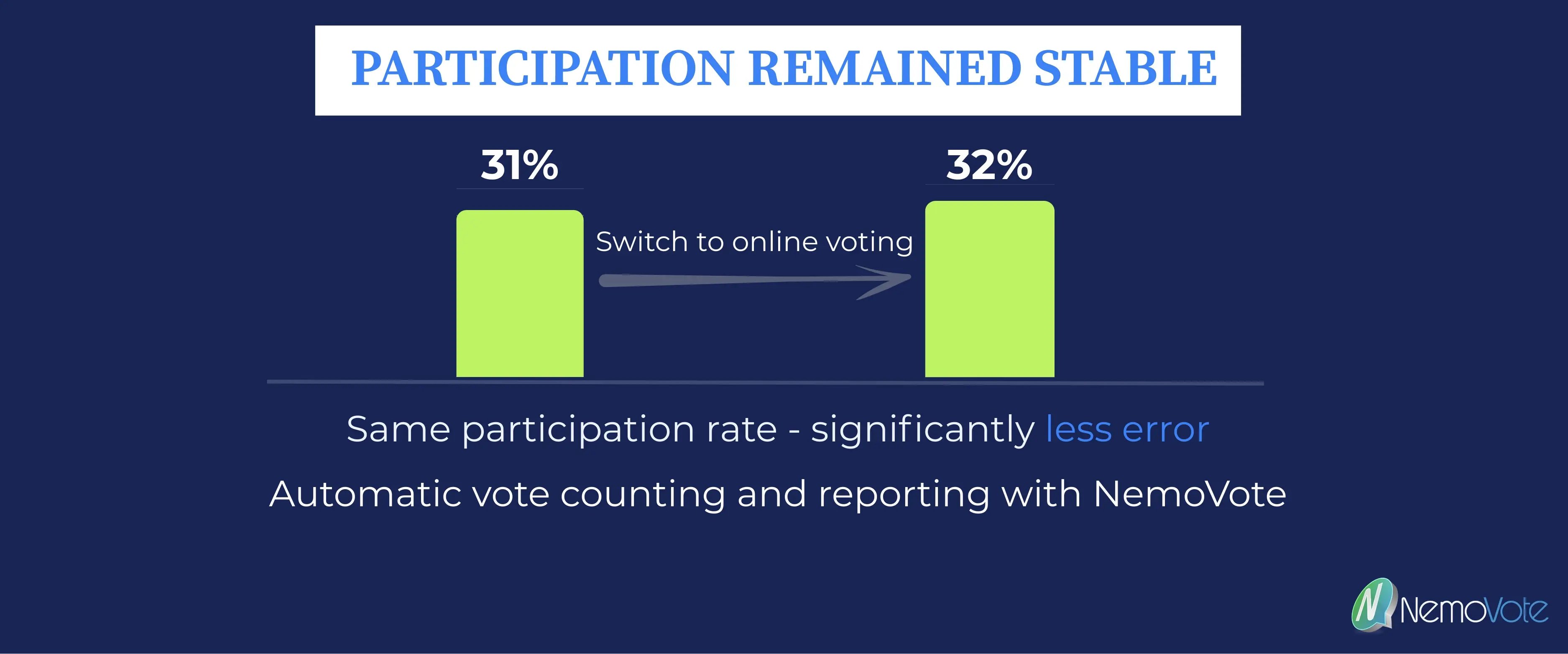
One concern before switching to digital voting was whether participation would decline.
The opposite happened.
Participation remained at least as strong as with postal voting
Election participation:
-
Postal voting previously: 31% turnout
-
Digital election with NemoVote: 32% turnout
It is important to note that this was not a strongly contested election. The vote served primarily as a confirmation of candidates, with two candidates for two positions.
This result confirmed that moving to digital voting increased engagement, by reducing existing hurdles.
Edgar Zühlke: “Participation did not decrease. It actually increased slightly compared to the postal election.”
8. A major benefit: No technical support needed during the vote
One of the most noticeable differences compared to previous elections was the lack of technical problems during the voting process.
During earlier elections, dozens of voters contacted the organization with questions such as:
-
Where are my login details?
-
How do I access the voting system?
-
My code does not work.
From hours to minutes:
With NemoVote, only two voters approached the administration, because they did not receive the credentials at first. After resending them, the problems have been solved in under 2 minutes, where it took other providers hours.
9. Results: Faster counting and professional documentation
The vote counting process also improved dramatically.
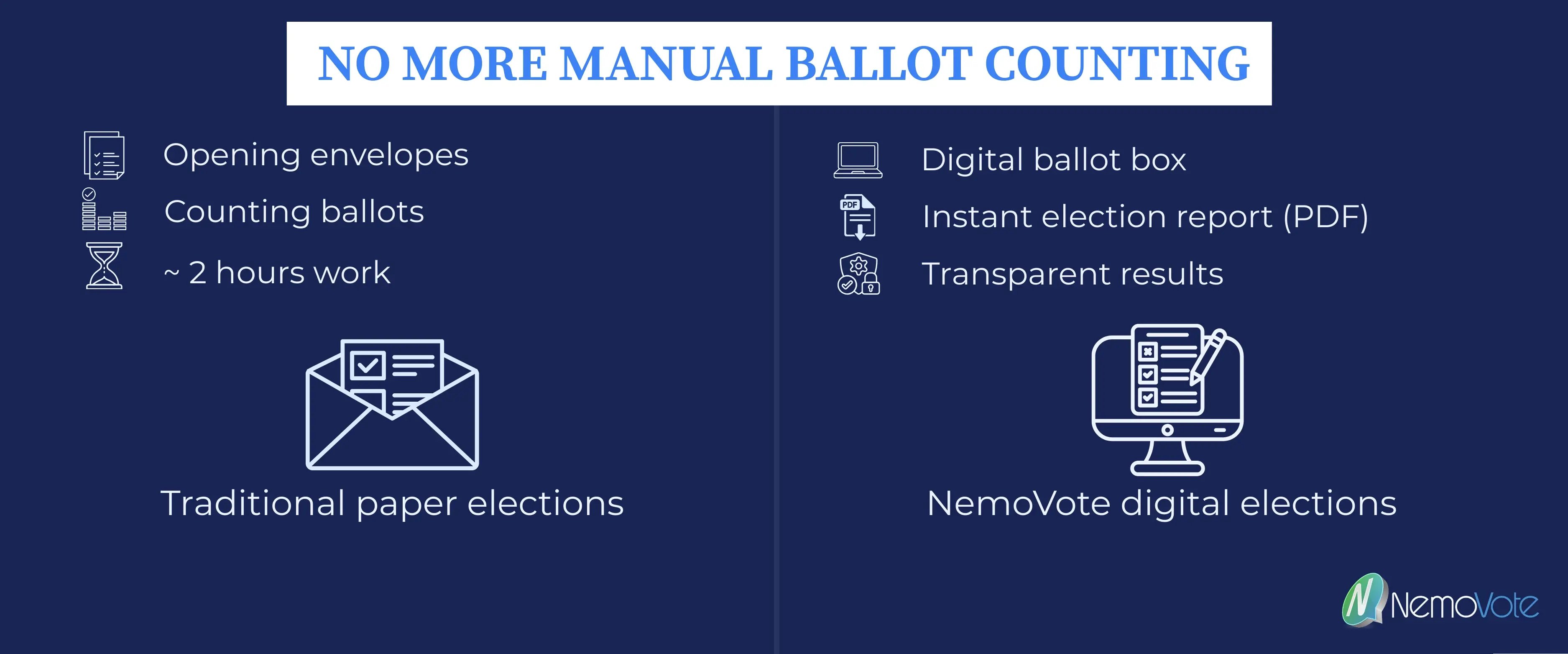
Previously:
-
manual vote counting took about two hours
-
election observers had to travel to the counting location
-
ballots were opened manually
With NemoVote:
-
votes were counted automatically
-
results were immediately counted
-
using the sealed voting feature, observers could verify the opening process transparently
The system also generated professional election reports automatically.
Edgar Zühlke: “The documentation was very impressive. A clean PDF report was generated immediately with all results.”
10. Learnings for organizations switching from paper voting
Based on the experience, several insights emerged for organizations considering digital elections.
1. Evaluate the real cost of postal voting
Postal elections require significant resources.
Organizations should consider:
-
printing costs
-
postage costs
-
administrative workload
-
manual vote counting.
2. Simplicity is critical for voter adoption
The easier the voting process, the fewer support requests occur.
Magic Links significantly simplified the process.
3. Digital vote counting saves hours of work
Automatic, immediate counting eliminates manual processes and reduces errors.
4. Transparency remains essential
Election observers were still involved and could verify the results, ensuring trust in the process.
Edgar Zühlke recommends NemoVote
“The best service is when you do not need it. This election ran smoothly and much simpler than previous ones.”
For Goodyear Retail Systems, switching to NemoVote significantly reduced effort while maintaining transparency and participation.
11. Conclusion: Digital elections simplify complex partner voting
The partner election organized by Goodyear Retail Systems shows how digital voting can simplify complex elections across large partner organizations.
The transition from postal ballots to online voting provided clear benefits:
-
drastically reduced administrative workload
-
secure and simple voting for partners
-
stable voter participation compared to postal voting
-
immediate results and professional election documentation
For organizations managing elections across distributed partner networks, digital voting offers a more efficient and transparent alternative to traditional paper-based processes.
More success stories:
FIVA's hybrid General Meeting: Proxy voting with weighting
Hybrid voting at World Sailing's General Assembly: AGM elections
Are you ready to run your election digitally?
Start a free test vote with NemoVote or book a live demo.