


Requirement UFO specification Voters High five-digit number of union members (30,000+ cabin crew...
Thousands of members across regions, shifts and workplaces. A collective bargaining round that can't wait weeks for a postal ballot. A result that has to hold up under scrutiny from members and employers.
Trade unions use online voting with NemoVote for union elections, strike ballots, delegate assemblies and council meetings. Results are ready in minutes, at an average of €0.80 per voter instead of €3 to €5 for a postal ballot.
Chapter
1. Typical votes in trade unions
2. The challenges: large memberships and secrecy
3. Online voting vs. postal ballot: costs and effort
4. Customer story: a digital strike ballot at UFO
5. Data protection and EU hosting
6. FAQ: Online voting for trade unions
Typical votes in trade unions
Unions hold five types of votes:
- Union elections: electing the executive board, works representatives, committees and officers.
- Strike ballots: asking members whether they support industrial action, often under time pressure during collective bargaining.
- Delegate assemblies: votes at conferences and congresses, often with weighted votes and proxies.
- Council meetings: binding decisions in smaller groups, such as the executive council or committees.
- Resolutions and member surveys: positions, statute changes and feedback on negotiation results.
With NemoVote, unions run all of these votes on one platform, fully online or hybrid, with members in the room and remote voting together.
➡️ Read more: Online voting for trade unions · Assemblies with elections for associations and trade unions
The challenges: large memberships and secrecy
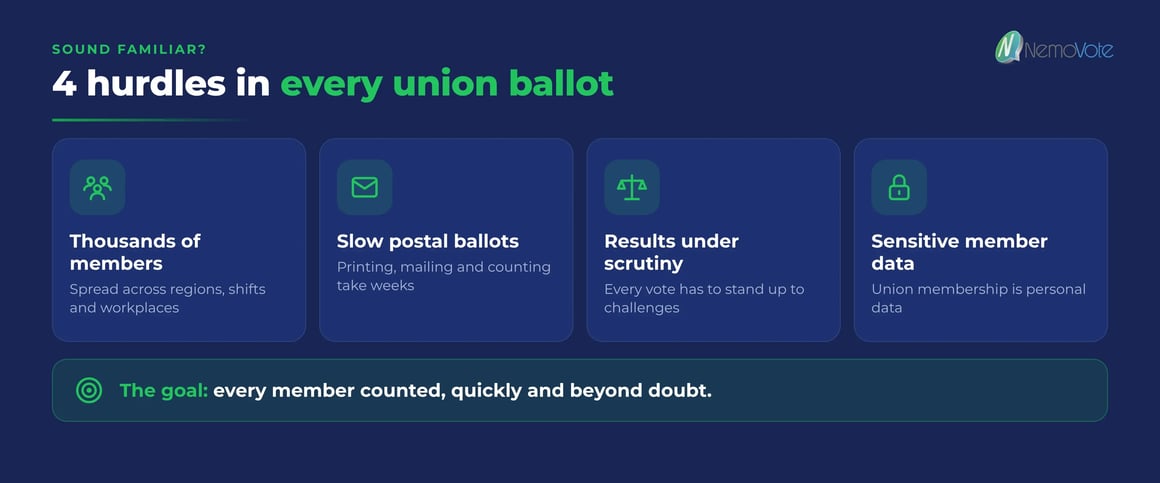
Union votes run into four hurdles:
- Thousands of members: spread across regions, shifts and workplaces.
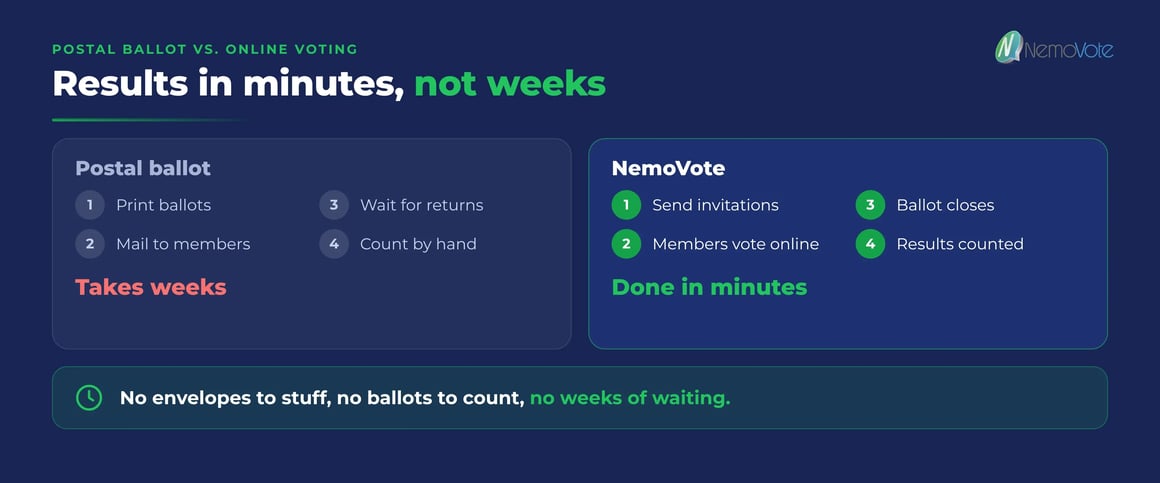
- Slow postal ballots: printing, mailing and counting take weeks.
- Results under scrutiny: every vote has to stand up to challenges, from members and from employers.
- Sensitive member data: union membership is personal data that needs special protection.
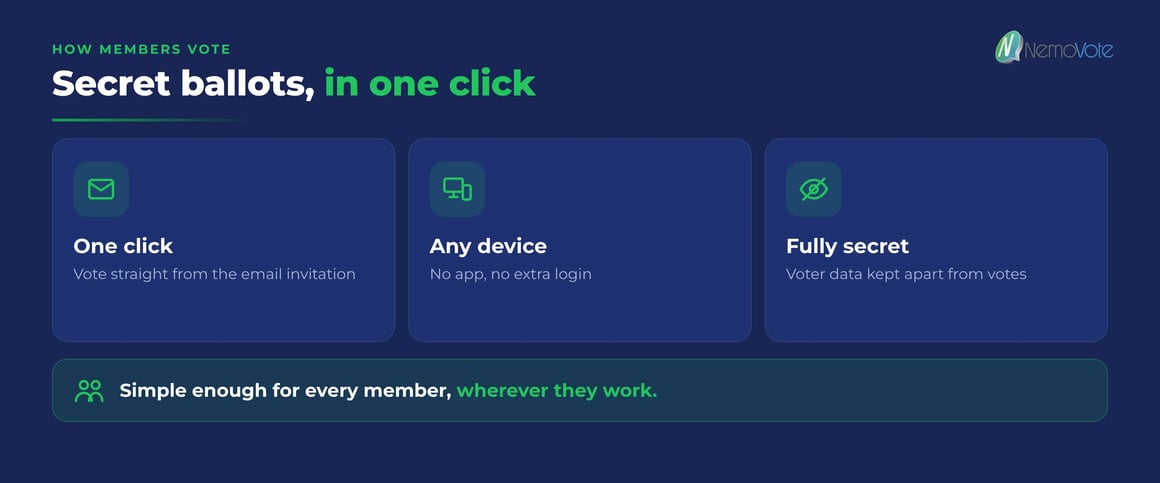
NemoVote solves this with a secret ballot every member can use:
- One click: members vote straight from the email invitation.
- Any device: no app and no extra login needed.
- Fully secret: voter data is kept apart from the votes.
➡️ Read more: Magic links: secure voting without passwords
Online voting vs. postal ballot: costs and effort
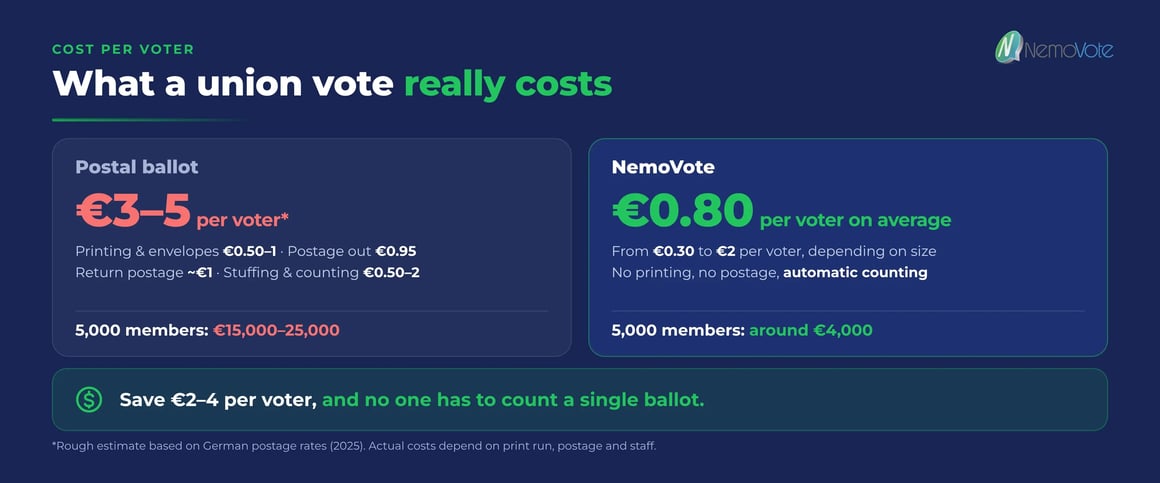
A postal ballot costs roughly €3 to €5 per voter: printing and envelopes (€0.50–1), outbound postage (€0.95), prepaid return postage (around €1) and staff to stuff envelopes and count ballots (€0.50–2). With NemoVote, a vote costs €0.30 to €2 per voter, €0.80 on average. For a union with 5,000 members, that's around €4,000 instead of €15,000 to €25,000.
| Postal ballot | Online voting with NemoVote | |
| Cost per voter | €3–5* | €0.30–2, €0.80 on average |
| Example: 5,000 members | €15,000–25,000 | Around €4,000 |
| Effort | Print, stuff envelopes, mail, collect returns, count by hand | Upload the member list and send invitations; counting is automatic |
| Speed | Several weeks | Results in minutes after the ballot closes |
| Participation | Ballots get lost, forgotten or arrive late | One click from any device, wherever members work |
| Documentation | Manual tally sheets | Every step on record, results as a PDF report |
*Rough estimate based on German postage rates (2025). Actual costs depend on print run, postage and staff.
No one wants to spend days stuffing envelopes and counting ballots by hand. With online voting, your staff skip that work entirely, and your union saves €2 to €4 on every voter.
Customer story: a digital strike ballot at UFO
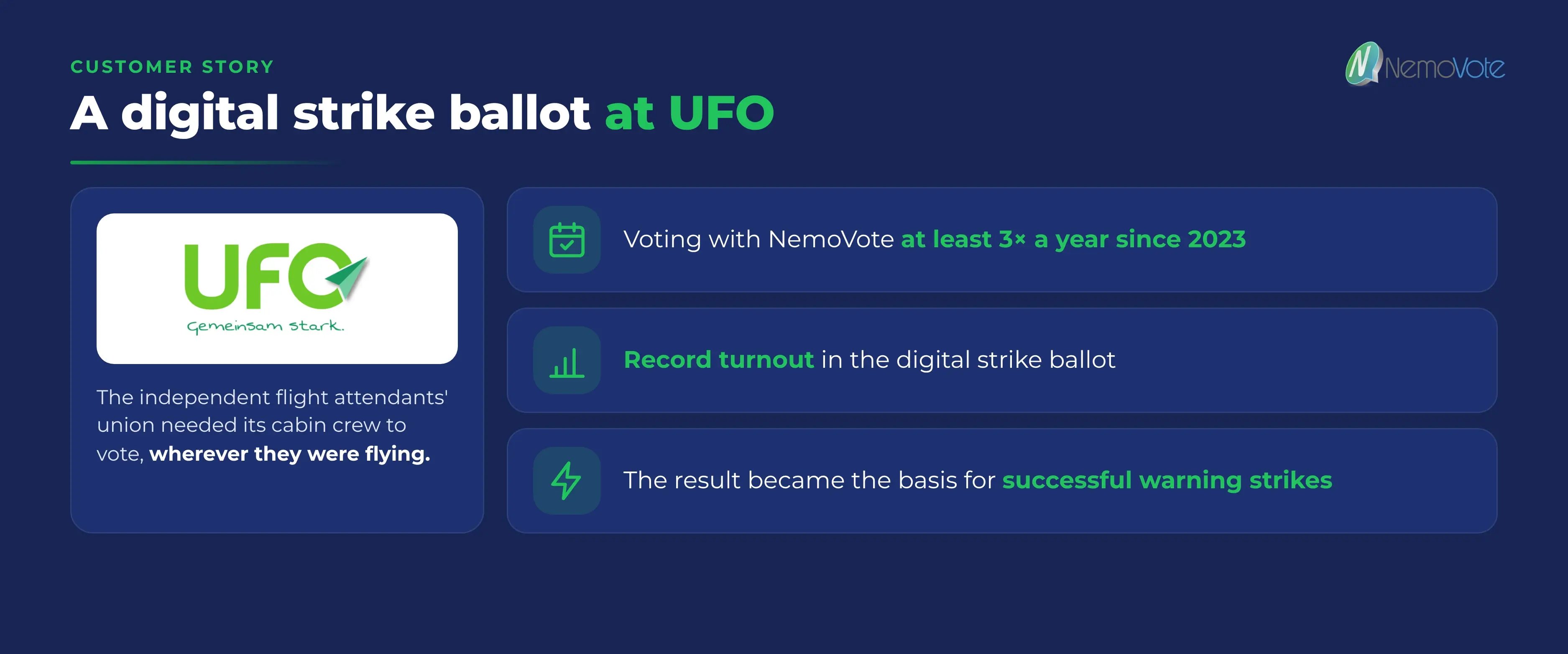
UFO, the independent flight attendants' union, needed its cabin crew to vote wherever they were flying. After months of unsuccessful bargaining with Lufthansa and Lufthansa CityLine, UFO held its strike ballot digitally with NemoVote.
- UFO has voted with NemoVote at least three times a year since 2023.
- The digital strike ballot brought record turnout.
- The result became the basis for successful warning strikes.
➡️ Read the full story: Union online voting: UFO casts with NemoVote for record participation
Data protection and EU hosting
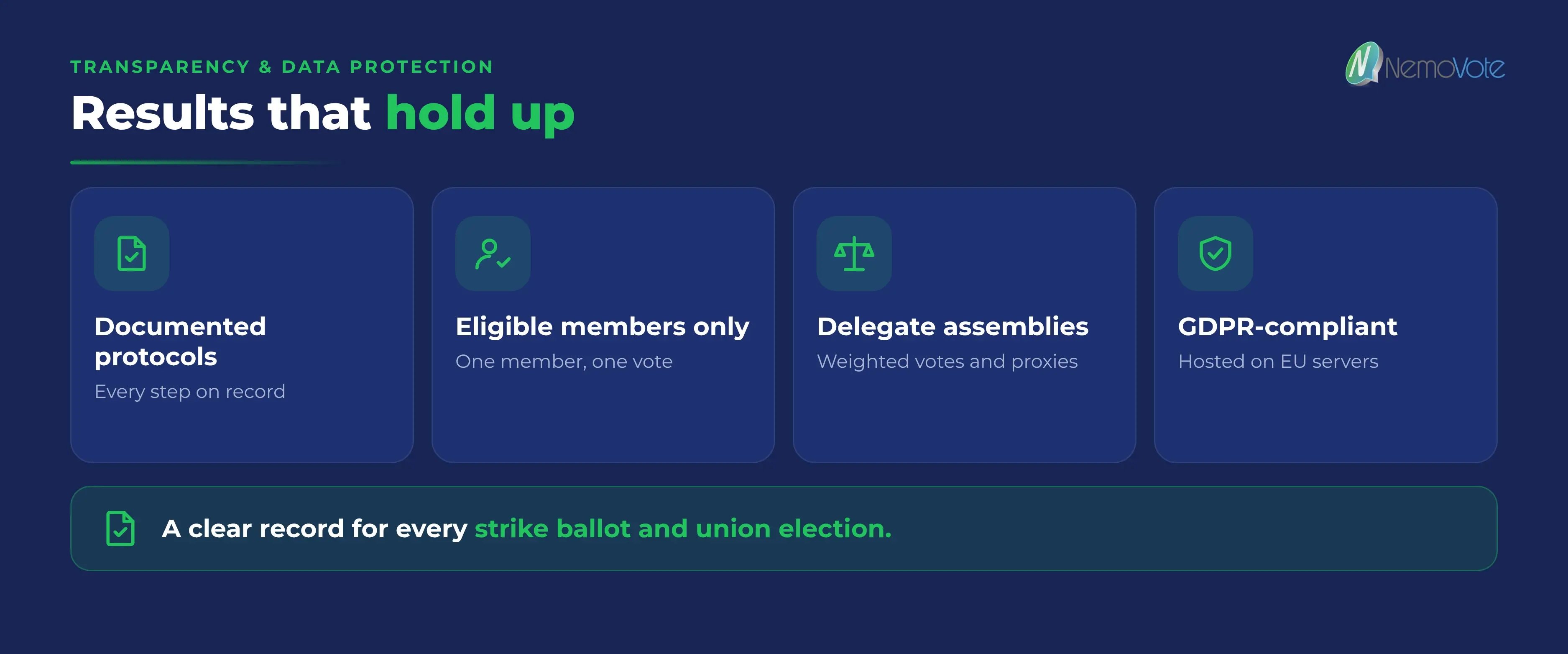
Under the GDPR, trade union membership is a special category of personal data, so strict data protection is a legal requirement for every union vote. NemoVote makes results hold up with:
- Documented protocols: every step is on record.
- Eligible members only: one member, one vote.
- Delegate assemblies: weighted votes and proxies, set up transparently before the vote.
- GDPR-compliant: hosted on EU servers, with a data processing agreement available.
➡️ Read more: Security and data protection at NemoVote · Proxy voting and weighting in practice · Who votes with NemoVote? Online voting for every organization
FAQ: Online voting for trade unions
What is online voting for trade unions?
Online voting for trade unions means that members cast their votes digitally, for example in union elections, strike ballots or at delegate assemblies. Members receive a personal invitation by email and vote with one click on any device.
Can a union hold a strike ballot online?
In many cases, yes. Whether a strike ballot can be held online depends on your union's statutes and the law in your country. In some countries, for example the UK, statutory industrial action ballots must still be held by post. Check your statutes and the legal requirements before your first online strike ballot.
Are online union votes secret?
Yes. NemoVote supports secret ballots: voter data is kept apart from the votes, so no one, including the organizers, can see how an individual member voted.
How much does online voting cost compared with a postal ballot?
NemoVote costs €0.30 to €2 per voter, €0.80 on average. A postal ballot costs roughly €3 to €5 per voter for printing, postage, return postage and counting.
How fast are the results?
Results are counted automatically and are available within minutes of the ballot closing, instead of weeks with a postal ballot.
Can we use weighted votes and proxies at delegate assemblies?
Yes. Votes can be weighted, for example by the number of members a delegate represents, and voting rights can be transferred to a proxy.
How many members can vote at the same time?
NemoVote scales from small committees with 10 voters to votes with tens of thousands of members.
Is NemoVote GDPR-compliant?
Yes. NemoVote is GDPR-compliant, hosts data on EU servers and offers a data processing agreement. This matters for unions, because union membership is a special category of personal data under the GDPR.
How can we try NemoVote?
Open the free live demo and see how a union vote works from the member's and the organizer's side:
Plan your next union vote with NemoVote
Strike ballots, union elections, delegate assemblies and council meetings: one click for members, results in minutes, around €0.80 per voter. Secret. Fast. GDPR-compliant.