

Legally compliant online elections are legally permissible, transparent and contestable elections...
Works Council elections shape employee representation across Europe, especially for multinational companies. While paper ballots remain common in Germany, secure digital platforms are standard elsewhere. Delivering compliance, transparency, and higher participation.
![aaron lesicar with microphone seemingly speaking and text below "is online voting illegal?"]()
![The Paradox: Online Voting is standard in Europe. Germany won't allow it for works council elections]()
![The loophole: German legal entities are not allowed to vote online for works councils. however european SEs, based in germany are allowed to vote online]()
![The real problem: Paper Ballots = lower participation rate, manual counting = slower results. Going digital fixes both]()
![Why Companies want digital voting: SSO Access, Easy Admin, Legally safe, instant results. Every company asks for it, germany wont allow it]()
![What do you think? Should works council elections finally go online everywhere?]()
Short & Sweet Summary
- ✅ Digital Works Council voting is legal across most European countries (CH, FR, UK, etc.)
- 🔒 Security-first online voting platforms ensure GDPR compliance + voter anonymity
- 📈 Proven results: 30-50% higher turnout, zero disputes, instant results
- 🇪🇺 Germany exception: SE registration enables digital elections
What You'll Learn in This Guide
- Paper Elections and Digital Ballots 2026
- Legal Landscape: Where digital voting works across Europe
- Real-World Success: Case studies from Nemovote implementations
- Germany Guidance: Practical paths forward
- Next Steps: Free security checklist download
Paper Ballots vs. Digital Voting in 2026
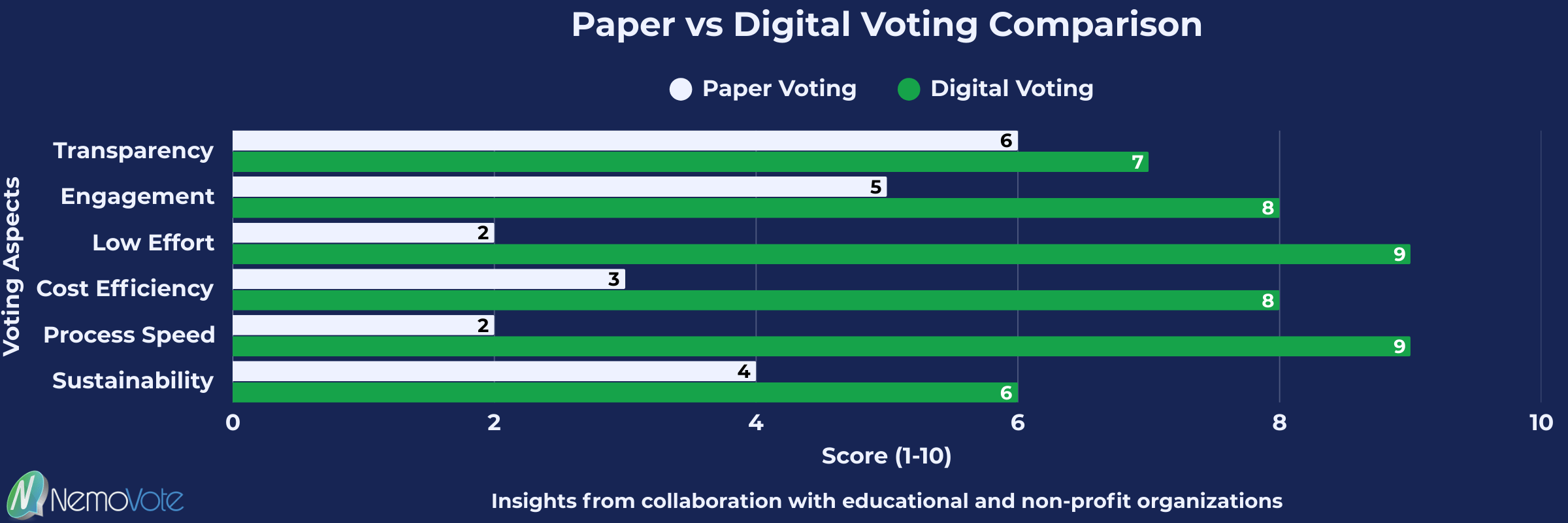
While traditional paper ballots have long been the standard, organizations are increasingly shifting to digital solutions. Why this change is happening now, is mostly because legal regulations have been lifted in many countries since COVID. Especially for Works Council elections across Europe, the inefficiencies of paper ballots are driving the move towards modern, digital voting platforms. No one wants lower voter participation and slower election outcomes back anymore.
In 2026, secure digital voting has become standard, instead of a luxury: Aiming for transparency, efficiency, and compliance, whilst reducing cost.
Legal Landscape for Works Council Elections Across Europe

The legal framework for digital Works Council elections varies across Europe, but the trend leans towards acceptance and standardization.
In Germany, the legal environment is more nuanced. While works council online voting is generally illegal for German GmbH/AG entities, it is permitted for companies registered as European SE (Societas Europaea), due to EU regulations applying. This regulatory loophole allows these entities to legally conduct secure digital elections.
Countries like Switzerland, France, and the UK have fully embraced digital voting, making it a common practice. Other EU countries also follow suit, albeit with some national variations.
However, legal compliance does not automatically equate to security, highlighting the importance of robust safeguards.
Essential Technical Security Measures for Online Voting
Security is the cornerstone of any digital voting system. Ensuring technical security involves multiple layers of protection:
- Encrypted Data Transmission and Storage: This ensures that data is encrypted from the moment it is sent until it is received, preventing unauthorized access.
- Single Sign-On (SSO) Integration (SAML/OAuth): SSO enhances security by allowing users to log in using a single set of credentials, reducing the risk of password-related breaches. It also makes voting more seamless for the voters. How SSO can be applied needs to be reviewed by your companies IT and the online voting providers IT departments.
- Multi-Factor Authentication (MFA): MFA adds an extra layer of security by requiring more than one form of verification to access the system.
Ensuring Process Security and Voter Anonymity
Process security is just as important as technical measures. Ensuring voter anonymity and verifiable eligibility are crucial for maintaining trust in the election process. Making sure that every voter is only able to cast ballots once and being able to archive the results is a MUST for every works council election. Enabling voter lists to group voters in regions, such that your workers are only able to vote for their representative, as well as enabling them to vote for more than one candidate needs to be included for most organisations.
Make sure that this works during your online works council election:
- Voter Anonymity
- Verifiable Eligibility
- Grouping Voters to a region
- Make sure a ballot can only be cast once and ballots can not be altered
- Archive the results securely
- Potentially enable voters to choose for more than one candidate per ballot.
- Are they allowed to proxy vote for someone else? Then the voting software provider needs to enable that as well.
Compliance with GDPR and National Election Laws
Compliance with data protection regulations like GDPR is non-negotiable. Agreeing to a Data Processing Agreement (DPA) with the voting provider is essential to stay legally safe.
National election laws must also be adhered to, ensuring that the digital voting process is legally sound.
ISO 27001 certification for servers used in the election process provides an additional layer of assurance, demonstrating that the highest standards of information security management are being followed.
Security Checklist for Digital Works Council Voting
| 🗳️ Feature | 👀 Why Important | 💡 NemoVote Implementation |
|---|---|---|
| Encryption | Protects data integrity | Uses TLS + AES-256 + HTTPS |
| SSO Integration | Simplifies secure access | Supports SAML/OAuth |
| Multi-Factor Authentication | Enhances login security | Available as an option |
| Voter Anonymity | Ensures confidential voting | Guaranteed through system design |
| GDPR Compliance | Legal requirement | Full adherence ensured |
| ISO 27001 Certification | High security standards | Certified servers in Germany |
| EU Servers | No one else has access to your data | EU + Germany based servers |
Learn more about secure online voting in our security blog
Case Studies: Successful Digital Works Council Elections
Real-world implementations of digital Works Council elections provide compelling evidence of their benefits.
For instance, a large subsidiary of Acceleron, TurboSystems, successfully conducted works-council-like elections for 850 employees using NemoVote. The results were impressive: a 30-50% increase in voter participation and zero disputes regarding the election outcomes.
Administrators lauded the platform for its real-time dashboards, automated reporting, and instant secure results. These success stories underscore the efficiency, security, and reliability of digital voting systems.
Germany-Specific Guidance


For companies in Germany, navigating the legal landscape for digital Works Council elections involves considering SE registration. This path allows for legally compliant online voting. Hybrid solutions can also be an effective approach, especially for organizations with international staff. Digital voting can be utilized for international employees, while traditional methods can be used for local staff, ensuring compliance with national regulations. Looking ahead, potential legal changes could further simplify the process, making digital voting more accessible for all entities.
Read more about what to look out for in Germanys local regulations in our article Online Elections: Challenges, first steps and legal security
Summary: Security Makes Digital Works Council Voting the Smart Choice
In conclusion, the security benefits and legal compliance standards of digital Works Council elections make them an intelligent choice for modern organizations. By prioritizing GDPR compliance, robust audit trails, and advanced encryption standards, companies can ensure that their elections are not only legally sound but also secure and efficient.
