
Choosing the right online voting software is more important than ever. Whether you’re running an...
Organizations looking for an Eligo alternative are usually not dissatisfied with digital voting itself: they are looking for more predictable costs, easier scaling, and greater flexibility over time.
Eligo is a well-established and secure online voting solution, particularly strong in formal and process-heavy environments. However, when organizations run elections only once every year or two or want clearer pricing and faster execution without coordination overhead, Eligo can reach its limits.
This article explains where Eligo performs well, where organizations start looking for alternatives, and why NemoVote is often chosen as the more flexible and cost-efficient option, without compromising security or reliability.
Let’s dive in.
Quick insights:
- Both platforms are modern and user-friendly: usability alone is not the deciding factor.
- NemoVote ranks #1 overall in our online voting software comparison, while Eligo ranks #5.
- Eligo is widely used in Italy: NemoVote is used in 32+ countries worldwide by NGOs, schools, unions, associations, and European Works Councils.
- NemoVote offers the smoother overall experience, especially for teams that value clarity, simplicity, and flexible governance workflows.
Looking for more comparisons? See how NemoVote performs against ElectionBuddy, POLYAS, Simply Voting, AssociationVoting, and OpaVote.
Chapter
- Benefits and challenges of Eligo voting software
- Ease of use for administrators and voters
- Pricing models and cost transparency
- From formal processes to real-time decisions
- Security standards and data protection
- Supporting hybrid and remote elections
- Global adoption and typical use cases
- Choosing between Eligo and NemoVote
- Why NemoVote fits most organizations
1. Eligo voting: Key features, benefits, and limitations
Eligo is one of the more established players in the European online voting market and is especially known in Italy.
In November 2025, Eligo was acquired by Lumi Global. As of February 2026, no detailed information has been published regarding product integration.
Its platform supports online, hybrid, and on-site voting, offers advanced cryptographic protections, and provides many optional add-on modules, such as:
- weighted voting
- proxy voting
- physical accreditation with QR
- two-factor authentication
- E2E verifiability (in higher-tier plans)
Eligo positions itself as a comprehensive, highly configurable solution for structurally complex organizations: federations, professional associations, companies, and unions.
However, several limitations become clear for many teams:
Major challenges with Eligo
- Pricing is unclear: Most costs are available only via request; public numbers exist only for “Light” packages.
- Many essential features are plan-dependent or unlocked via add-ons.
- Feature availability changes by plan, which can increase coordination and final costs.
Eligo remains strong for compliance-heavy institutions, but many organizations seek a simpler, faster, more intuitive voting experience.
That is exactly where NemoVote stands out.
2. User experience: Both platforms are intuitive
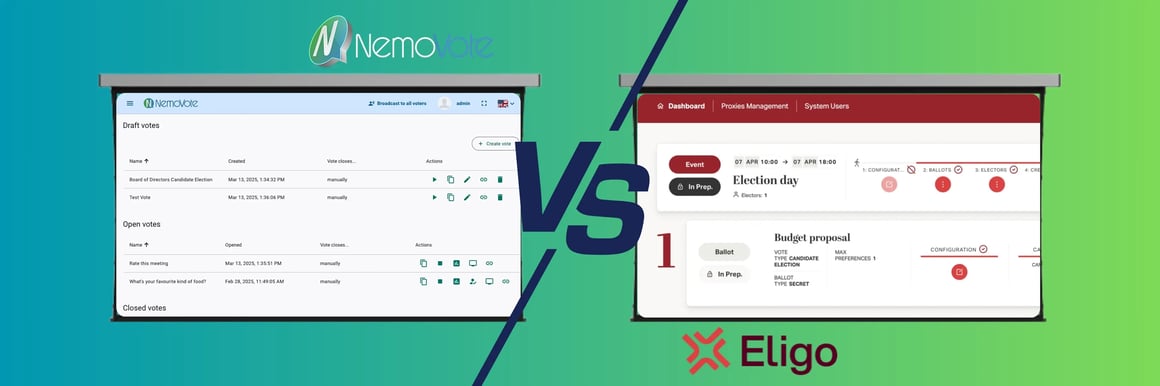
Both NemoVote and Eligo offer modern, well-designed interfaces that are easy to understand for administrators and voters alike. Eligo provides a structured and professional user experience, especially suited for organizations familiar with formal voting processes.
NemoVote is also designed to be intuitive and accessible, allowing administrators to create and manage elections quickly without technical expertise. Typical actions include:
- setting up votes in a short time,
- adding documents, links, or contextual notes,
- importing large voter lists with instant upload,
- tracking quorum and participation live,
- managing the entire process from a single dashboard.
For voters, both platforms work smoothly across devices such as smartphones, laptops, tablets, and desktop browsers, without requiring apps or plugins.
However, feature availability plays an important role in the practical user experience for administrators. The Light plan is designed for straightforward voting scenarios, while advanced workflow automation features are available for recurring, long running, or multi phase elections. These functions are essential for reducing manual effort, especially for associations running elections over a period of time and live votings, which need ad-hoc changes, such as general assemblies. When they are plan-restricted, administrators may need additional coordination or upgrades to achieve the same level of efficiency.

NemoVote includes these features as standard, which simplifies recurring election workflows and reduces administrative overhead.
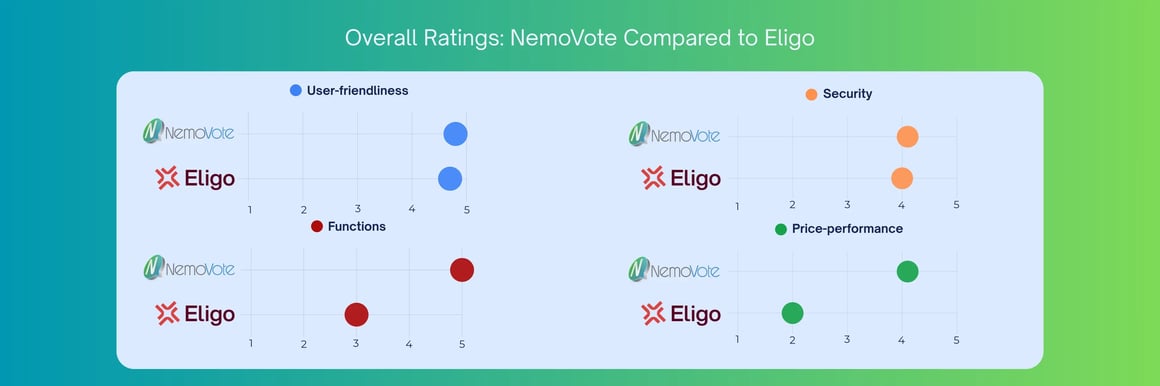
In our comparison, NemoVote scores 4.8/5 for user-friendliness, while Eligo scores 4.7/5, confirming that both platforms deliver a strong user experience.
Why organizations look at pricing first
User experience alone is rarely the decisive factor when associations choose an online voting platform. In practice, price structure and long-term cost predictability play a much larger role: especially for organizations that conduct elections every year or multiple times per year.
Both platforms provide modern and intuitive interfaces, while offering different approaches to pricing and post election governance features.
3. Transparent pricing with no hidden fees
Final pricing reflects election scope and governance requirements, as is standard across professional voting platforms.
Eligo pricing: Base price first, features later
Eligo offers three plans, but full functionality is typically available only in higher tiers.
Free Trial
- Free for 7 days
- Up to 10 voters
- Only a few basic features included
- No support
This plan is mainly a test environment, not suitable for running a real election.
Light plan (paid)
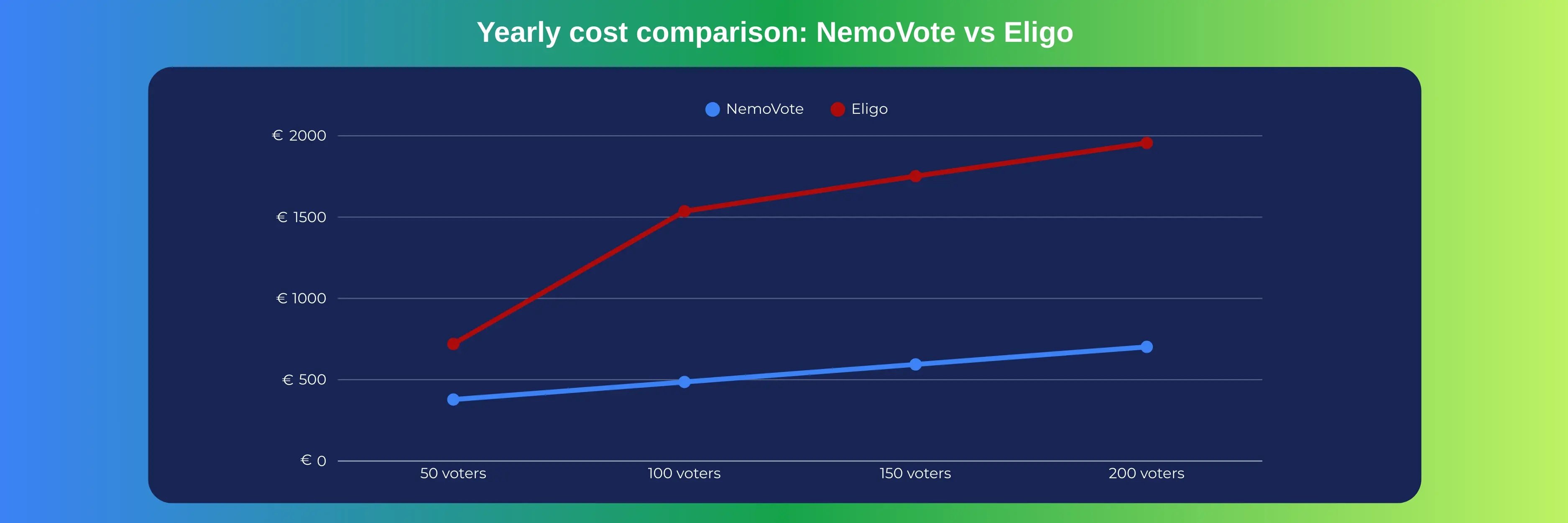
Starts at €720/year and increases depending on voter count:
| €720/year | 1–50 voters |
| €1.536/year | 51–100 voters |
| €1.752/year | 101–150 voters |
| €1.956/year | 151–200 voters |
Included: participation status, observer access, theme customization
Not included: event duplication, automatic opening, automated reminders, voting receipts: features that are core to many real elections.
Pro plan
| Pricing | Custom quote |
| Voter limit | On request |
| Features | Depends on configuration |
| Election duration | Depends on contract |
Eligo supports both one time voting events and recurring election workflows.
NemoVote pricing: Everything included from the start
NemoVote keeps things simple. All essential features: security, accessibility, real-time tools, and unlimited elections during the subscription, are included by default.
| Subscription model (unlimited elections) | Event model (one-time elections) |
| €378/year for 50 voters | €99/event for 50 voters |
| €486/year for 100 voters | €129/event for 100 voters |
| €594/year for 150 voters | €159/event for 150 voters |
| €702/year for 200 voters | €189/event for 200 voters |
Subscription model
Ideal for teams running several elections per year:
You get permanent access, data storage, full branding options, and no limitations.
Event model (one-time elections)
Perfect for annual assemblies or single elections:
Includes full functionality, setup access 3 days before and after the election, and all basic voting features.
In our price-performance comparison, NemoVote scores 4/5, while Eligo scores 2/5 due to plan-dependent features and custom pricing.
4. Designed for real-time governance, not bureaucracy
Modern organizations do not just vote once per year. They need dynamic, real-time decision-making, and NemoVote was built for this.
NemoVote enables real-time governance
- quorum validation
- participation tracking
- instant encrypted results
- PDF decision records
- live communication tools
- multi-language ballots
Eligo also supports structured processes, but its configuration is more oriented toward formal, multi-step environments.
For quick, flexible decision-making, NemoVote provides a much smoother workflow, reducing admin time and simplifying participation.
5. Modern security & complete GDPR compliance
Both NemoVote and Eligo offer a high level of security and data protection. The difference lies less in whether they are secure, and more in how security is implemented and accessed.
In our comparison, both NemoVote and Eligo score 4/5 for security, with Eligo emphasizing cryptographic depth and NemoVote focusing on strong enterprise security without added complexity.
NemoVote security approach
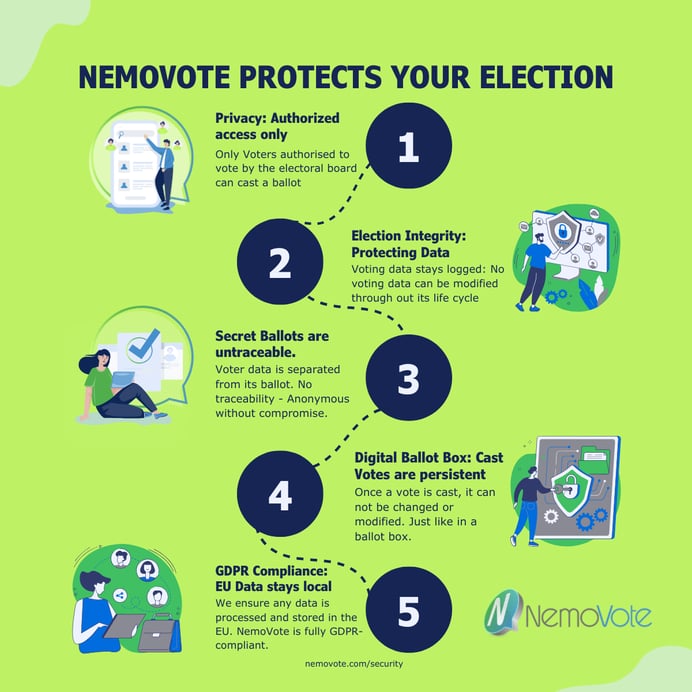
NemoVote focuses on delivering strong, enterprise-grade security by default, without adding operational complexity for administrators.
Key security features include:
- AES-256 encrypted ballots
- Clear separation of voter identity and vote content
- GDPR-compliant hosting exclusively in Germany
- ISO-27001 / 27017 / 27018 certified data centers
- Traceable decision records
- Strict role-based access permissions
This setup makes NemoVote suitable for organizations that need reliable protection for sensitive votes, while keeping setup and operation simple.
Eligo security approach
Eligo places a very strong emphasis on cryptographic and procedural security.
Eligo offers:
- 3072-bit asymmetric encryption
- HTTPS-based end-to-end encrypted processes
- Vote immutability and coercion protection
- Strong data separation mechanisms
Security takeaway
Both platforms meet high security standards and GDPR requirements.
Eligo may be the better fit for organizations that prioritize maximum cryptographic depth and formalized security processes, while NemoVote delivers full enterprise security in a more accessible and operationally lightweight way.
6. Hybrid & remote voting: Which platform performs better?
Hybrid and remote voting are no longer optional: they are essential.
NemoVote’s hybrid advantages
- instant join via secure magic links
- no downloads, no plugins
- QR-access for on-site voter verification
- perfect for remote assemblies
- multi-device support
- real-time participation monitoring
- accessible UI (BITV/WCAG standards)
Organizations report that remote voters join NemoVote events in under 10 seconds.
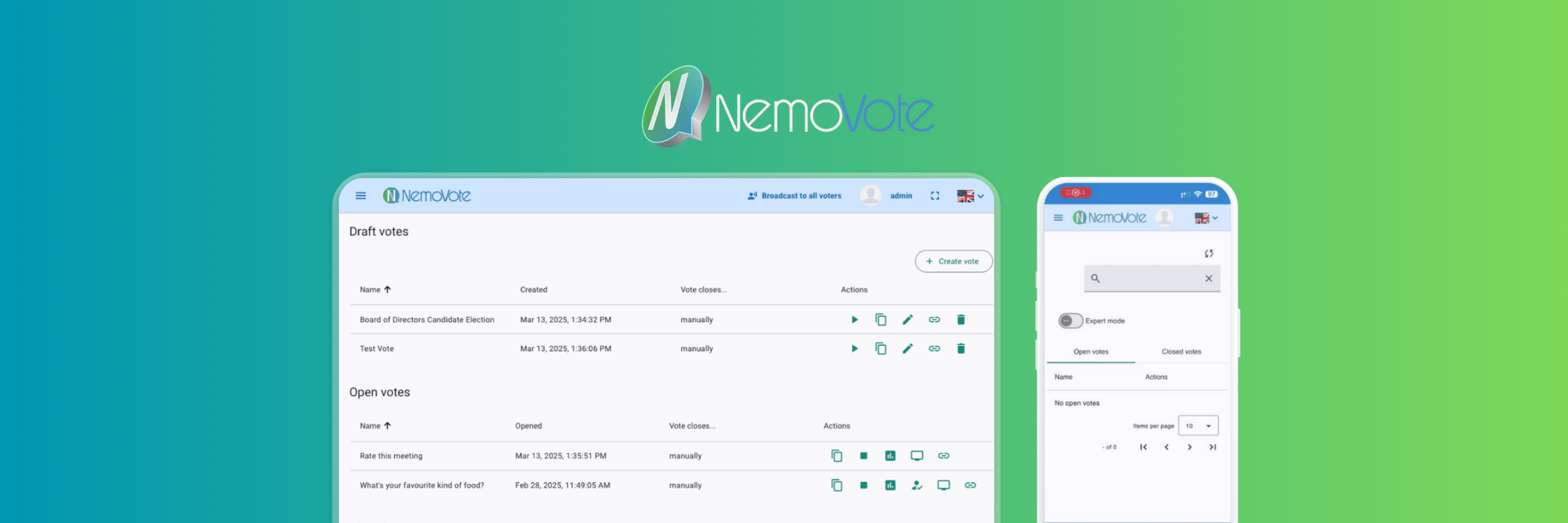
Eligo’s hybrid workflow
Eligo supports hybrid events and integrations with tools such as Microsoft Teams and Zoom, with optional advanced configuration for complex or highly controlled voting scenarios. For fast, simple hybrid voting, NemoVote provides the smoother experience.
7. Who uses NemoVote worldwide
NemoVote is used by organizations in 32 countries, including:
- NGOs, like international and regional non-profits with 20 to 20,000 voters
- Large federations, like World Sailing and the World Medical Association
- Trade unions, like German UFO with more than 10,000 eligible voters
- Universities and schools, like GO! With more than 700 schools in Belgium across Europe
- European Works Councils, coordinating cross-border employee representation
- International youth organizations, conducting recurring and time-limited votes
The platform works equally well for different organizational structures, including small associations, large federations, clubs, academic institutions, charities, and youth groups. Its flexibility and intuitive setup make it accessible for both first-time election organizers and experienced administrators managing complex voting scenarios.
Eligo has a strong and established presence in Italy and is also used by organizations across Europe, Latin America, the United Kingdom, and the United States, supporting a broad range of institutional and non-institutional use cases.
8. Verdict: Which one should you choose?
| Eligo may be a suitable choice if… | NemoVote may be the better choice if… |
| Your organization is large or highly institutionalized and prefers structured, process-driven election workflows | You are looking for a modern, intuitive platform that is easy to use for both administrators and voters |
| Your voting procedures involve multiple formal steps, approvals, or legally formalized coordination | You value transparent and predictable pricing, especially over multiple election cycles |
| You are comfortable working with custom quotes, tailored configurations, and longer setup cycles | You need fast setup, remote participation, and real-time results |
| Eligo appears particularly well suited for large organizations with formal governance structures that prioritize procedural depth and detailed configuration | For many organizations, especially small to mid-sized associations, federations, councils, and recurring election bodies, NemoVote offers a well-balanced combination of usability, flexibility, security, and pricing |
9. Overall winner for most organizations: NemoVote
Modern organizations need simplicity, reliability, and transparency.
NemoVote delivers all three:
- clear, intuitive design
- enterprise-grade security
- real-time governance tools
- transparent pricing with no hidden fees
- full flexibility for online, hybrid, and remote assemblies
If your organization requires GDPR compliant voting on an easy to use platform, NemoVote is the online voting tool with the smaller price tag.
Ready to try it yourself?
Start a free test election in NemoVote.